

A meal can look, smell, and taste perfectly normal while carrying microbes picked up somewhere between the shopping bag and the dinner plate. That journey contains a handful of moments when microorganisms either multiply, move to a new surface, or get shut down. Small handling decisions at those points shape much of the risk of foodborne illness at home.
The science behind safer food preparation explains why familiar food safety rules exist rather than merely repeating them. Heat, soap, and cold do not do the same job: one destroys microorganisms, another loosens and removes them, and the third limits their growth. Understanding those differences reveals why certain shortcuts have little consequence while others remove the only barrier between contamination and a finished meal.
The Short Answer: Time, Temperature, and Transfer
Nearly every household food safety rule controls one of three variables: time, temperature, or transfer. Many bacteria multiply most quickly between roughly 5°C and 63°C, so chilling, prompt cooling, and careful storage all reduce the time food spends in that range.
Heat provides the dependable kill step. Cleaning removes and dilutes foodborne pathogens, while refrigeration slows their multiplication without necessarily destroying them. Transfer completes the picture because microbes can travel from raw ingredients to ready-to-eat food on hands, knives, chopping boards, taps, and cloths.
The World Health Organization (WHO), the CDC, and the Food Standards Agency (FSA) express this through household guidance often condensed into the 4 Cs: cleaning, cooking, chilling, and cross-contamination. Underneath that shorthand sits the same plain-language logic used in commercial hazard analysis: identify where contamination could occur, control that point, and check whether the control worked. The important distinction is what each control physically achieves. Cleaning reduces contamination, cooking destroys susceptible organisms, and chilling buys time.
Why Cleaning Removes More Microbes Than It Kills
A clean-looking surface is not sterile. In an ordinary kitchen, cleaning means lowering the number of microbes and removing the food residues that support them. That distinction matters because wiping a worktop can either carry contamination away or spread it across a wider area, depending on the cloth and method used.
What Soap Does to a Bacterial Cell
Soap molecules have a water-attracting end and a fat-attracting end. The latter interacts with oils, grime, and the lipid membranes surrounding many microorganisms, helping to loosen them from skin and surfaces. Water then suspends and carries that material down the drain.
That is why handwashing with soap depends on friction and time. Rubbing for around 20 seconds reaches folds, fingertips, thumbs, and areas around nails, while rinsing completes the mechanical removal. Soap can disrupt some microbial membranes, but routine washing does not sterilise hands.
Norovirus makes the transfer mechanism especially clear. It persists on surfaces and commonly reaches food through contaminated hands, often after cooking has finished. In that route, effective hand hygiene matters more than relying on a later heat step that never occurs.
The Transfer Routes Most People Miss
Chopping boards get plenty of attention, but damp cloths and sponges are often the quieter problem. Moisture and trapped food particles let microbes persist, so a cloth that looks acceptable can distribute contamination to handles, counters, and plates.
Raw meat drips can carry Campylobacter, while Listeria can move between refrigerated foods and surfaces. Sink splashes during rinsing, reusable shopping bags, and hand-to-handle contact while cooking create further cross-contamination routes. Raw meat, therefore, belongs sealed on the lowest fridge shelf, and cloths need regular replacement or effective hot washing.
Professionals do not judge cleanliness by sight alone: regulators publish thresholds, processors run rapid microbiological tests from developers, including NEMIS Technologies AG, and home cooks are left with proxies like separate boards and fresh cloths. Those proxies work because they interrupt transfer rather than pretending every surface has been sterilised.
Heat Is the Only Step That Reliably Kills
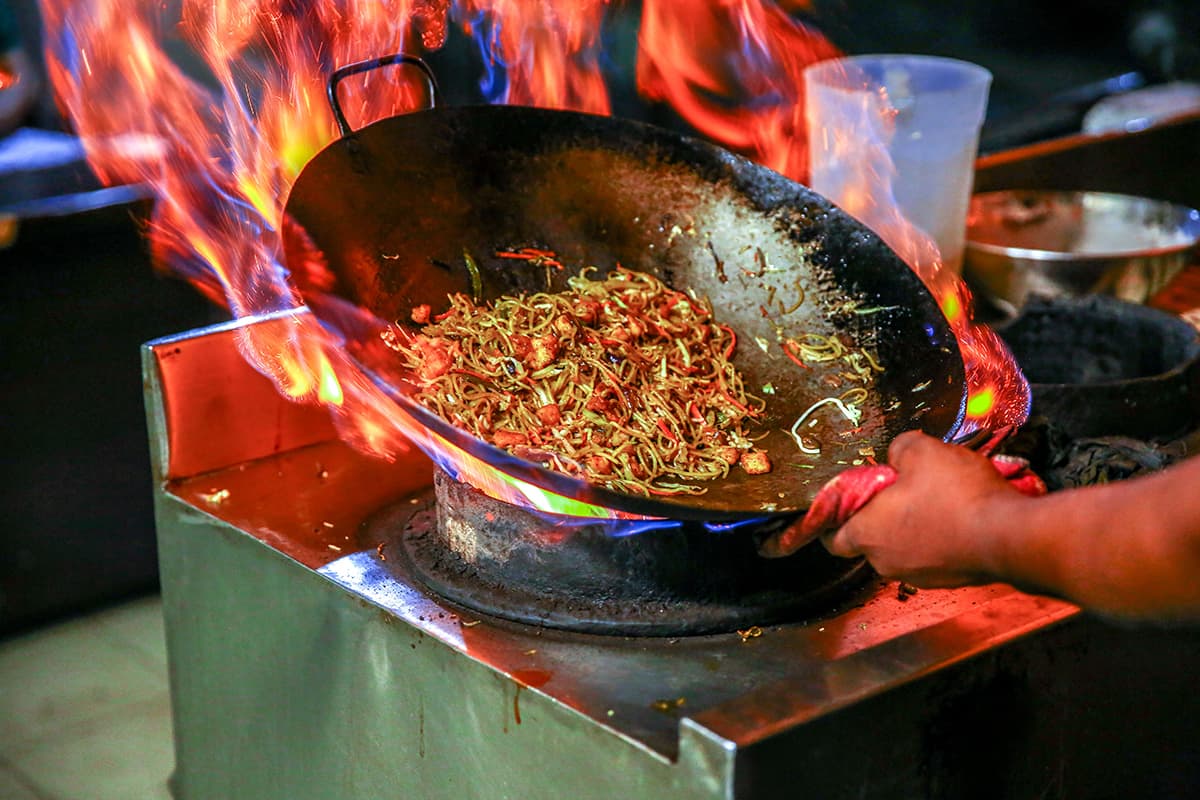
Heating food damages the proteins and enzymes that bacteria need to maintain their structures and reproduce. The effect depends on both temperature and exposure time, which is why a browned exterior or bubbling sauce cannot prove that the centre has received an adequate heat treatment.
The Core Temperatures Worth Measuring
A practical household benchmark is roughly 70°C for two minutes or a core reading of 75°C. The thermometer probe belongs in the thickest part of the food, away from bone, because the coolest section determines whether cooking has reached the required internal temperature. Using a food thermometer replaces guesswork with a direct measurement.
This is especially important with undercooked poultry. Campylobacter and Salmonella can occur on and within a raw bird, while sufficient cooking destroys them. Minced meat also needs thorough cooking because grinding can carry surface contamination, including E. coli O157, throughout the product.
Time and temperature work together. A lower temperature must generally be sustained longer, whereas a higher core temperature achieves the same microbial destruction more quickly.
Myths the Science Does Not Support
Myth: Washing chicken makes it safer. When preparing raw chicken, rinsing does not provide a reliable kill step. Instead, splashing can spread bacteria around the sink, taps, utensils, and nearby food.
Myth: Colour and smell reveal whether meat is safe. Meat can brown before reaching a safe core temperature or remain pink after thorough cooking. Smell mainly signals spoilage organisms, not necessarily the pathogens responsible for illness.
Myth: Reheating rescues food left out too long. Bacillus cereus spores can survive cooking and later germinate in foods such as rice. Some bacteria can also produce heat-stable toxins, so cooking is not a reset button once unsafe storage has allowed those hazards to develop.
Chilling Slows Bacteria, It Does Not Kill Them
Cold reduces the speed of bacterial metabolism and division. Refrigeration and chilling, therefore, extend the time available for safe storage, but they do not erase earlier contamination. Freezing pauses most microbial growth without sterilising food, and surviving organisms can become active again after thawing.
The Two Hour and Two Day Windows
Cooked food should move through the warm growth range quickly and reach refrigeration within about two hours. Large pots cool slowly at the centre, so dividing soups, sauces, and stews into shallow containers allows heat to escape faster.
Most cooked leftovers are best treated as a two-day proposition and reheated until steaming hot throughout. Repeated warming and cooling add more time at temperatures that support multiplication, so reheating only the portion required reduces that exposure.
Rice needs particular care. Bacillus cereus spores can survive initial cooking, then germinate while rice stands at room temperature. Rapid cooling matters more than expecting reheating to repair poor storage.
Raw meat belongs on the lowest fridge shelf in suitable food-safe wrapping materials, where leaking juices cannot drip onto cooked dishes, fruit, or other ready-to-eat foods. Packaging controls transfer, while refrigeration controls growth.
Foods and People at Higher Risk
Listeria shows why refrigeration only buys time: it can continue multiplying at typical fridge temperatures, particularly in ready-to-eat food stored for extended periods. Pregnancy, older age, early childhood, and weakened immunity reduce the margin for error because these vulnerable groups face greater consequences from infection.
For these households, unpasteurised milk and dairy products should be replaced with pasteurised products. Raw or lightly cooked eggs require appropriate handling and thorough cooking, sprouts are safer cooked rather than raw, and raw seafood should give way to properly cooked alternatives. Immunocompromised and vulnerable groups also benefit from shorter storage periods for chilled ready-to-eat foods.
Bringing the Science Back to Your Own Kitchen
Familiar kitchen rules stop feeling arbitrary once each one has a clear purpose. Soap and rinsing remove contamination, sufficient heat destroys susceptible microbes, and cold delays their multiplication. Separation prevents organisms from bypassing those controls by moving onto food that will not be cooked again.
That mental model makes food safety easier to judge. A shortcut involving tidiness is not equivalent to skipping the only kill step, while refrigeration cannot reverse contamination or excessive time at room temperature. Understanding removal, destruction, delay, and transfer turns routine habits into deliberate barriers against foodborne illness.
There aren't any comments left behind yet you can be the very first to comment!